
HIPAA does not stop a dental office from calling patients, leaving voicemails or talking with family members. It asks for four things: verify who you're talking to when you don't know them, share only what the caller needs, use professional judgment with family when the patient isn't there, and honor a patient's request to be contacted a particular way.
By Viktoria Mols, CMO · Published October 30, 2026 · 13 min read
On a Wednesday afternoon a woman calls and says she is the daughter of one of your patients. Her mother had a root canal last week, the daughter is helping with the bills, and she wants to know what the remaining balance is and whether the crown appointment is still on Friday. She sounds kind, organized and entirely genuine. Can you tell her?
Front desks hesitate on calls like this one, and the hesitation usually comes from a version of HIPAA that is stricter than the real thing. The rules allow more than many people think — including, often, helping that daughter — and they forbid a few specific things that people do every day without noticing. This guide walks through what the Privacy Rule actually says about phone calls, with the section of the regulation for each point and scripts for the calls that come up most.
General information, not legal advice. State laws can be stricter than HIPAA, and your practice's own policies apply. Check anything you're unsure of with your privacy officer or counsel.
Everything else on this page is those four rules applied to real calls.
When the patient calls about their own appointment or bill, you still need to be reasonably sure it's them. The habit that matters most is simple: ask the caller to state the details — never read them out and ask for a yes. "Is your date of birth April 5th, 1980?" confirms a stranger's guess. "Can you give me your date of birth?" checks it.
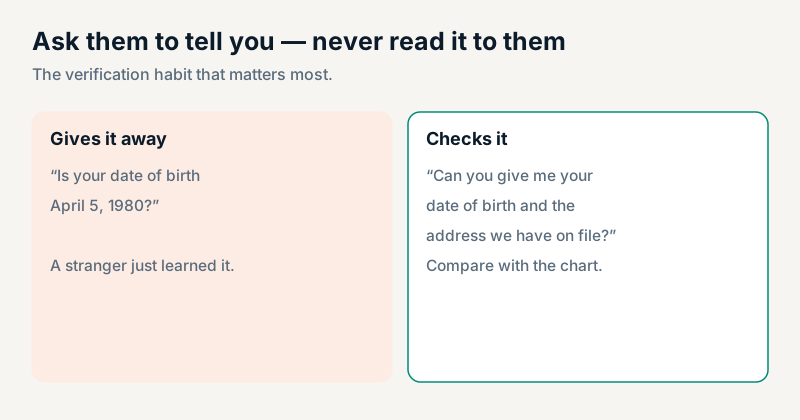
Two identifiers are a sensible minimum — full name and date of birth, plus the address or phone number on file when the call is about anything sensitive or financial. Write your practice's rule down so everyone verifies the same way.
I'm happy to help with that. So I can pull up the right record, could you give me your full name and date of birth? … And the address we have on file? … Thank you, I've got you.
Con gusto le ayudo. Para encontrar su expediente, ¿me da su nombre completo y su fecha de nacimiento? … ¿Y la dirección que tenemos registrada? … Gracias, ya le encontré.
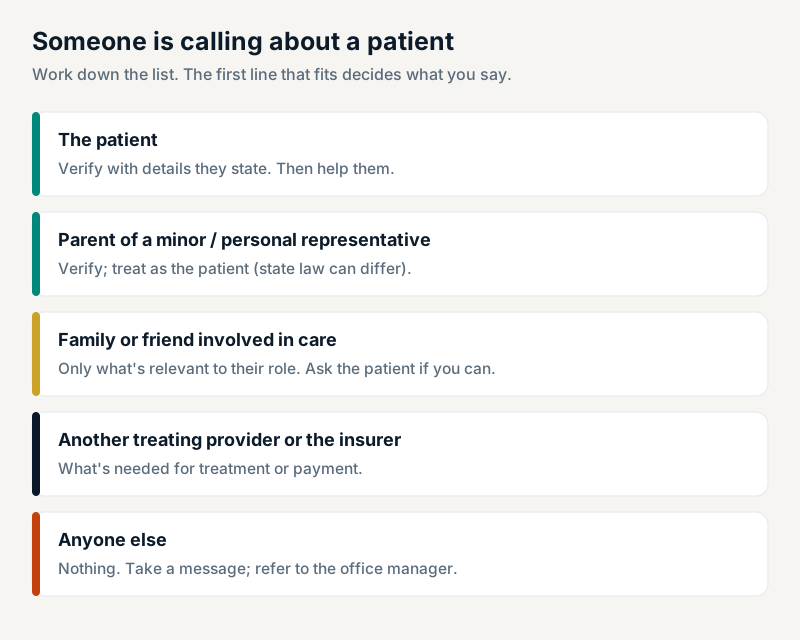
Back to the daughter. The Privacy Rule lets you share information with a family member, relative or close friend that is directly relevant to their involvement in the patient's care or payment for it (45 CFR 164.510(b)). A daughter who is helping pay the bill is involved in payment; the balance and the appointment time are relevant to that. The details of the root canal are not.
The same rules let you talk to a spouse who calls to move an appointment, or a friend who is driving the patient home after sedation, about exactly the part they're involved in.
Thanks for helping your mother with this. I can confirm her appointment is on Friday at 10, and that there's a balance on the account. For anything about her treatment itself, I'll need to speak with her — would you like me to call her, or can she call us?
Gracias por ayudar a su mamá con esto. Le confirmo que su cita es el viernes a las 10 y que hay un saldo pendiente en la cuenta. Para cualquier detalle de su tratamiento necesito hablar con ella. ¿Prefiere que la llamemos o que ella nos llame?
A parent of a minor is generally the child's personal representative and can be treated like the patient for HIPAA purposes, with exceptions set by state law — some states let older minors consent to certain care themselves (45 CFR 164.502(g)). The same applies to a legal guardian, or to someone holding a healthcare power of attorney for an adult. Verify them the same way you would verify the patient, and note the relationship in the chart. Where parents are separated, don't assume either one can or can't access records; check what your practice has on file and, if there's a court order, follow it.
You may share what's needed for treatment and payment — the specialist you referred the patient to, the lab making the crown, the insurer processing the claim (45 CFR 164.506). An insurer asking about a claim can get what that claim needs. A specialist's office can get the X-rays they asked for.
Everyone else gets nothing by phone: employers, lawyers, landlords, reporters, and callers you can't place. That isn't rudeness; it's the rule. Take a name and number and pass it to the office manager. Requests from law enforcement and courts have their own procedures and belong with the manager or the privacy officer, not the front desk.
HHS addresses this directly: the Privacy Rule does not prohibit leaving messages on a patient's answering machine, but you should limit what you say — for example, your name and number and what's needed to confirm an appointment, or simply a request to call back (HHS FAQ 198). You may also leave a message with whoever answers the phone, using professional judgment and keeping it limited.
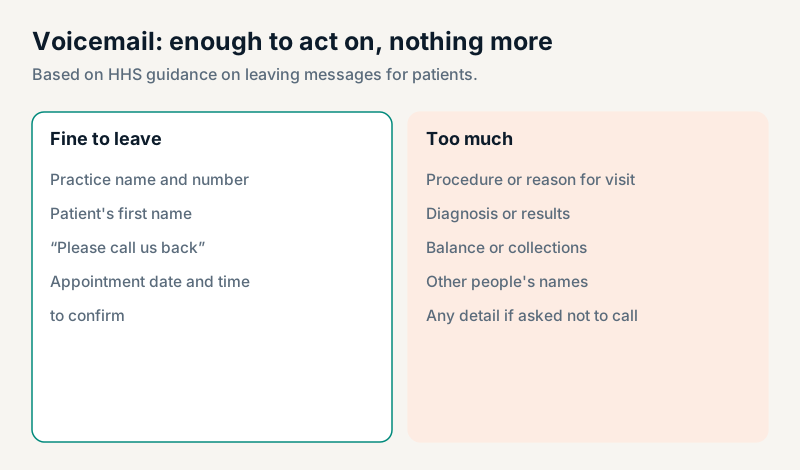
Hi, this message is for Maria. This is Jen from [Practice] at [phone]. We're calling to confirm your appointment on Friday at 10 a.m. Please give us a call back. Thank you.
Hola, este mensaje es para María. Le habla Jen de [Consultorio], al [teléfono]. Le llamamos para confirmar su cita del viernes a las 10 de la mañana. Por favor, llámenos. Gracias.
"Please only call my cell." "Don't leave anything on the home phone." "Mail statements to my work address." These are confidential-communication requests, and the rule is firm: a dental practice must accommodate reasonable requests to receive communications by alternative means or at alternative locations, and may not require the patient to explain why (45 CFR 164.522(b)).
The practical failure is not refusing — nobody refuses — it's forgetting. The request is made once at the desk, written on a sticky note, and three months later a recall call goes to the home number. Put the instruction where everyone will see it: a flag or alert in the patient's record in your practice software, so it appears every time anyone opens the chart or dials the patient.
Not every slip happens on the phone. Patients in the waiting room hear what is said at the desk. The Privacy Rule accepts that some incidental disclosure is unavoidable — calling a name in the waiting room, for instance — as long as you have reasonable safeguards. In practice: lower your voice, confirm details by pointing at the screen or the form rather than reading them aloud, and keep diagnoses and balances off the counter conversation. If a call needs detail, offer to call the patient back from a quieter spot.

The same principles apply to written messages: send appointment information, not clinical details, to the number or address the patient gave you, and honor any request about how they want to be contacted. Texting patients also has carrier and consent rules that have nothing to do with HIPAA — they're covered in A2P 10DLC for dental practices and, for recall messages, in dental recall scripts and templates.
The same rules, applied to calls that come up every week. These reflect a cautious reading of the Privacy Rule; your practice's policy may be stricter.
| The call | A reasonable answer |
|---|---|
| A husband calls to reschedule his wife's cleaning. | Fine to move it. He is involved in her care; an appointment time is relevant and limited. |
| The same husband asks why she needs a crown. | Clinical details go to the patient. Offer to have the dentist call her. |
| An adult son asks for copies of his father's X-rays. | Records requests need the patient's authorization or a personal representative. Take the request and contact the patient. |
| A mother asks about her 9-year-old's appointment. | Verify her, then help — she is normally the child's personal representative. |
| A caller says "I'm from her insurance" and asks for her treatment history. | Verify the caller and the purpose; share what the claim needs. If unsure, call the insurer back on the number on the card. |
| An employer asks whether an employee really had an appointment this morning. | Nothing without the patient's written authorization. Offer the patient a visit note they can give their employer themselves. |
| The patient asked you to call only her cell; the cell goes to voicemail. | Leave a limited message on the cell. Don't try the home number. |
| Someone says "I'm calling for my neighbor, she can't hear well" and asks for her balance. | You can't confirm their involvement. Take a message and arrange to speak with the patient, or have her confirm the neighbor can help. |
For what a vendor that handles your calls must do to protect patient data — a signed BAA, encryption, who can see call records — see is an AI receptionist HIPAA compliant? and Dentovox's own security page.
The same principle — never confirm someone is a patient — applies to online review replies; HHS has settled with dental practices over it. See how to get more Google reviews, within the rules.
Yes. HHS says the Privacy Rule does not prohibit leaving messages on a patient's answering machine, but practices should limit the information — for example, the practice name and number, what is needed to confirm an appointment, or a request to call back (HHS FAQ 198).
Yes, about what is directly relevant to that person's involvement in the patient's care or payment — such as an appointment time or a balance — with the patient's agreement when they are available, or using professional judgment when they are not (45 CFR 164.510(b)).
Ask the caller to state identifying details — such as full name, date of birth and the address on file — and compare them with the record. Never read the details out and ask the caller to confirm them; that gives the information to anyone who calls.
Yes, if the request is reasonable. A covered health care provider must accommodate reasonable requests to receive communications by alternative means or at alternative locations, and may not require the patient to explain why (45 CFR 164.522(b)).
Generally yes — a parent is usually the minor's personal representative under HIPAA — but state law sets exceptions, and court orders between separated parents can change who has access. Verify the parent as you would the patient and follow what is on file.
Create an account free — no card — build your receptionist, and hear it handle a call on the spot. Your own number activates when you start a plan.