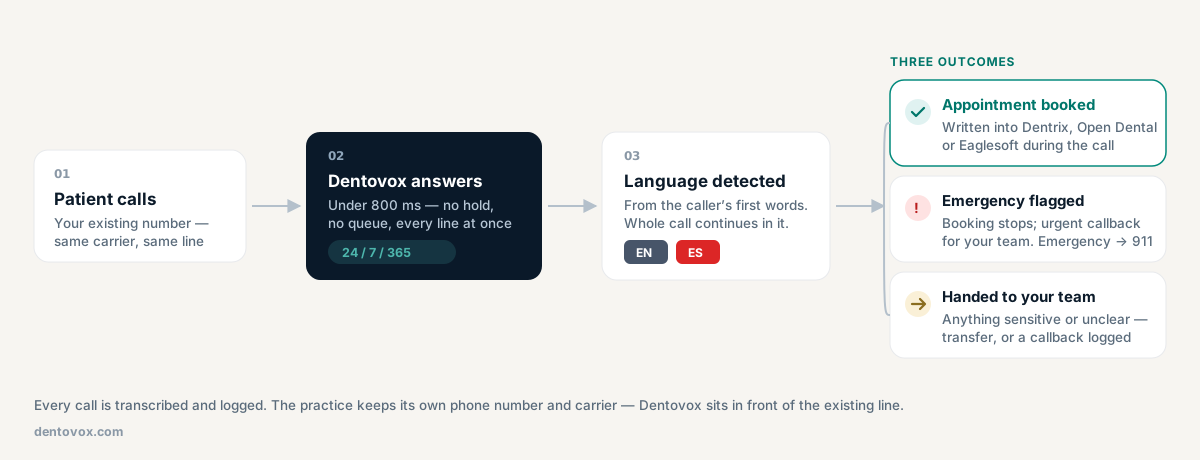
What the AI does with each type of call
"Answers the phone" is not a specification. A dental front desk gets a handful of recurring call types, and the useful question is what happens to each one. This is the actual routing.
| Call type | What Dentovox does | Where it ends up |
|---|
| New patient wants an appointment | Takes intake details, reads live availability, books the visit | Appointment in your PMS, with the call note attached |
| Existing patient, hygiene recall | Matches the patient, offers real times for the right provider | Appointment in your PMS |
| Reschedule or cancel | Verifies identity, moves or releases the existing appointment | Updated in your PMS; released slot matched to the waitlist |
| Hours, address, parking, what you accept | Answers from what you configured | Resolved on the call |
| Urgent or after-hours emergency | Stops the booking flow; transfers to your line while open, urgent callback when closed; directs true emergencies to 911 | An urgent callback flagged for your team |
| Insurance, benefits, what will this cost | Does not quote or verify — routes to your team | Transfer to your line in office hours, callback request outside them |
| Clinical question | Does not advise; hands off | A person |
| Vendor, sales, wrong number | Handles and closes it | Logged, and off your team's plate |
Everything is transcribed either way. Every call — booked, transferred, or closed — leaves a searchable transcript in the dashboard, so a disputed conversation is a lookup rather than a memory test. Spanish calls follow exactly the same table; language is detected from the caller's first words and never changes what the system is willing to do, as described on the bilingual page.
What gets written down, and who can correct it
A booking is a row of fields. A phone call is not. The things a caller says that no field asks for are exactly the things the front desk wants to know before the patient sits down, and in most systems they are buried in a transcript nobody opens.
The receptionist writes a note onto the appointment. Which tooth. How long it has been hurting. Who is driving the patient in. What they want to ask the doctor once they are in the chair. The note sits on the appointment in the dashboard, so whoever opens the day's schedule reads it before the patient walks in rather than after. It is editable at the desk — if the note is thin, wrong, or picks up something the caller said later, your team rewrites it.
The patient record is yours to correct. Name, phone number, date of birth, preferred language: every field the agent fills is a field a telephone line can mishear. All of them are editable in the dashboard, in one place, so a misheard name is fixed once instead of being re-typed into each new appointment. The record also carries a note that belongs to the person rather than to any single visit — allergies, who brings them, how they pay — which stays attached the next time they call.
None of this reaches the chart. Charting, perio, claims, and the ledger stay in Dentrix, Open Dental, or Eaglesoft; notes and patient details live in the Dentovox dashboard alongside the transcript, under the controls listed on the security page. What moves between the two is availability and appointments, as described on the scheduling page.
Emergency language stops the booking flow — in code
The failure mode that matters on a dental phone line is not a wrong appointment length. It is a caller describing a swelling that is closing their airway, and a scheduling script cheerfully offering them Thursday at 2.
So the scheduling flow cannot continue once emergency language has been heard. Pain, swelling, and bleeding are matched by code, in English and in Spanish, before the model gets a turn: the booking step halts deterministically and an urgent callback is opened for your team. This is a rule in the system, not a decision the model is trusted to make well on the call where it matters — which means it behaves the same way on the thousandth call as on the first, and the same way at 2am as at noon.
Signs that belong in an emergency room are pointed there rather than into a callback queue. Dentovox is not an emergency service: a genuine medical or dental emergency means calling 911 or going to the nearest emergency room, and the AI says so plainly rather than booking around it. Everything short of that goes to your team — transferred to your line while the office is open, or flagged as an urgent callback request when it is closed — see after-hours dental answering for how practices usually set those rules up.
What happens to calls that don't finish
Most "missed-call recovery" exists because nobody picked up. Here every line is answered live — nights, weekends, lunch and the third simultaneous call — so those calls are handled instead of missed. When a call cannot be finished by the AI, a callback request with the caller's number and reason lands in the dashboard for your team, and every call, including one the caller abandons, is logged with its outcome and transcript. Dentovox does not run an automatic callback campaign to abandoned calls today; how that compares with the rest of a recovery stack is on the AI receptionist + patient recovery page.
What the AI will not do
The boundaries are the product. A front-desk automation that never says "let me get someone" is one that eventually says something wrong about a patient's care or their bill.
- It does not give clinical advice. Symptom questions route to a person. The AI schedules; it does not triage.
- It does not quote costs or verify benefits. Coverage and out-of-pocket questions go to your team, because a confident wrong number on the phone becomes an argument at checkout.
- It does not replace emergency care. Urgent calls go to your team, and a genuine medical or dental emergency means calling 911 — the AI says so plainly.
- It does not improvise. When it does not know, it transfers to the line you set during office hours or logs a callback with the caller's number and reason. It does not guess to keep the conversation moving.
- It does not hide what it is. Dentovox is transparent about being an AI, and every call leaves a recording and transcript your team can review.
- It does not touch clinical records. Charting, perio, claims, and the ledger stay in your practice management system; Dentovox reads availability and writes appointments, nothing more.
How it fits onto the phone system you already have
The most common objection to front-desk automation is not the AI — it is the fear of a phone migration during a working week. There isn't one.
You forward your existing line to Dentovox. You keep your current carrier and your current phone number. Nothing on the desks changes, no handsets are replaced, no new telephone platform is introduced, and the forwarding rule can be turned off as easily as it was turned on (how overflow forwarding works). Because there is no hardware, most practices are live within a day.
From there you decide how much of the volume the AI takes. Some practices start with after-hours and weekends only — the pattern described in after-hours dental answering — and extend into peak-hour overflow once they have listened to a week of transcripts. Others hand it everything from day one. Both are configuration, not a different plan.
The practice management connection is separate and equally small: Dentrix, Open Dental, or Eaglesoft through NexHealth, so availability is read live and the appointment is written back during the call. Setup details per system are on the Dentrix, Open Dental, and Eaglesoft pages.
What the front desk stops doing
The point of automating the phone is not headcount — it is that a receptionist cannot answer a ringing line while also seating a patient, and the ringing line loses. Industry estimates put unanswered inbound calls at roughly a quarter to a third of volume†, concentrated exactly at the hours when the desk is busiest.
Example math: a practice taking 400 calls a month that misses 25% of them loses 100 conversations. If even a tenth of those were new patients who booked elsewhere, the arithmetic against a $299–$749 monthly plan is not close. Use your own numbers rather than these on the ROI calculator, and see the full cost breakdown in what missed calls cost a dental practice.
† Industry estimates, not Dentovox's measured results.
Beyond answering, the same system runs scheduling with a double-booking guard, two-way SMS in English and Spanish, and reactivation campaigns against your lapsed list. Plans run $299 Overflow, $499 Front Desk, $749 Revenue, and $649 Multi-Location per location per month, 10% off annually, with bilingual answering included at every tier — see pricing.
Security, HIPAA, and the paperwork
Phone calls to a dental practice carry protected health information, so the compliance posture is not an afterthought. Dentovox is built HIPAA-aware: PHI is encrypted in transit and at rest, each practice's data is isolated from every other practice's, and sensitive actions are audit-logged. Your practice accepts a Business Associate Agreement before it can go live — not after a trial, before it. The controls are itemized on the security page, and the question of what "HIPAA compliant" does and does not mean for a vendor is unpacked in is an AI receptionist HIPAA compliant.