
A first call from a new dental patient should end with a booked visit, and it usually takes four to six minutes. Do six things in order: greet with your name, find out why they are calling, check for urgency, take contact details, answer the insurance question without promising coverage, and offer two specific times before you hang up.
By Viktoria Mols, CMO · Published October 30, 2026 · 14 min read
It is 12:40 on a Tuesday. Your front desk is at lunch, and a woman who moved to town three weeks ago is sitting in her kitchen with a list of four dental offices her neighbor recommended. She calls the first one. If someone answers, says their name, and offers her a cleaning next Thursday at 9, she will book it and stop calling. If the phone rings out, she moves to the second name on the list.
That is the whole job of a new-patient call: turn a stranger who is comparing practices into a name in your schedule, before she hangs up. Everything below — the order of the questions, the exact words, what to leave for later — exists to make that happen in about five minutes, with a caller who feels looked after rather than processed.
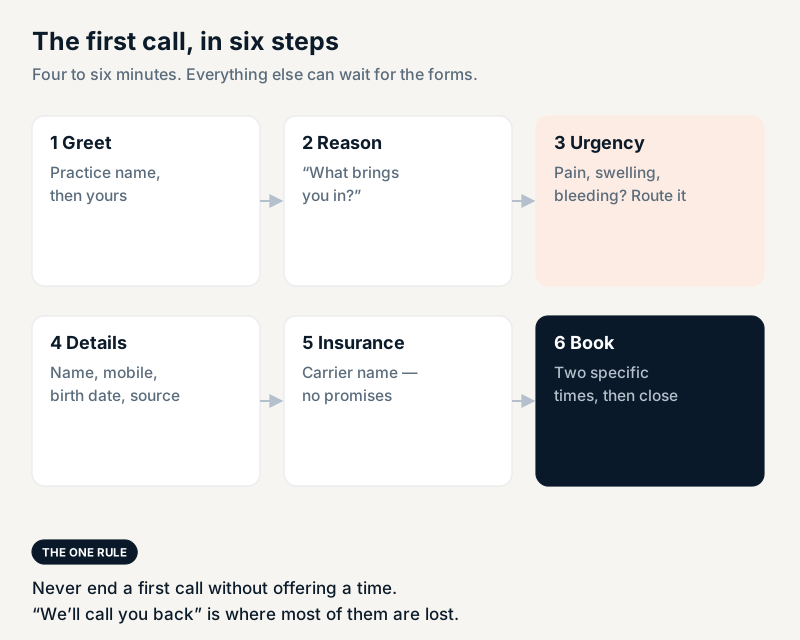
New callers decide quickly. The first ten seconds tell them whether they reached a real office; the first minute tells them whether anyone is listening. A call that opens with "date of birth?" feels like a form. A call that opens with "what brings you in?" feels like a conversation — and the answers to the form questions come more easily once the caller trusts you.
The order also protects the one thing that matters most: urgency. A caller who mentions swelling or pain in the second minute needs a different path from someone who wants a routine cleaning, and you only find that out if you ask why they are calling before you ask for their insurance.
Placeholders are in square brackets. Read it a few times, then say it in your own words — callers can hear when someone is reading.
Answer by the third ring, say the practice name first and your own name second. Smile while you say it; it changes the sound of your voice more than you would expect.
Good afternoon, [Practice], this is [Your name]. How can I help you today?
Buenas tardes, [Consultorio], le habla [Su nombre]. ¿En qué le puedo ayudar?
Let them talk. Write down the reason in their own words — "my crown came off," "I haven't been to a dentist in five years and I'm nervous" — because that note is what your dentist will read before the visit, and it is far more useful than a category.
Welcome — we'd be glad to see you. What's bringing you in? Is this for a checkup and cleaning, or is something bothering you?
Bienvenido/a, con gusto le atendemos. ¿Qué le trae por aquí? ¿Es para una revisión y limpieza, o tiene alguna molestia?
If they mention pain, ask three short questions. You are not diagnosing anything — you are deciding which kind of appointment to offer and how soon. Your dentist should decide in advance which answers mean "same day," which mean "first available," and which mean the call goes to them now.
I'm sorry you're dealing with that. So I can find the right appointment: is there any swelling in your face or jaw? Is anything bleeding? And how would you rate the pain — is it keeping you up at night?
Siento mucho que tenga esa molestia. Para buscarle la cita adecuada: ¿tiene hinchazón en la cara o la mandíbula? ¿Le sangra algo? ¿Y qué tanto le duele? ¿No le deja dormir?
If a caller describes trouble breathing or swallowing, or swelling that is spreading, tell them to call 911 or go to the nearest emergency room. That line belongs in every front-desk script, and it is not a judgment the person at the desk should have to make alone.
Only what you need to put them in the schedule and reach them again. Read the phone number back — a wrong digit is the most common reason a booked new patient becomes unreachable.
Let me get you set up. Can I have your first and last name? And the best mobile number to reach you — let me read that back: [number]. What's your date of birth? Last one: how did you hear about us?
Vamos a registrarle. ¿Me da su nombre y apellido? ¿Y el mejor número de celular para comunicarnos? Se lo repito: [número]. ¿Su fecha de nacimiento? Una última pregunta: ¿cómo supo de nosotros?
"How did you hear about us?" is the only marketing question worth asking on the call. Ask every time and write the answer down exactly — "Google," "my neighbor Ana," "the sign on Main Street." After three months it will tell you which of your marketing actually brings patients.
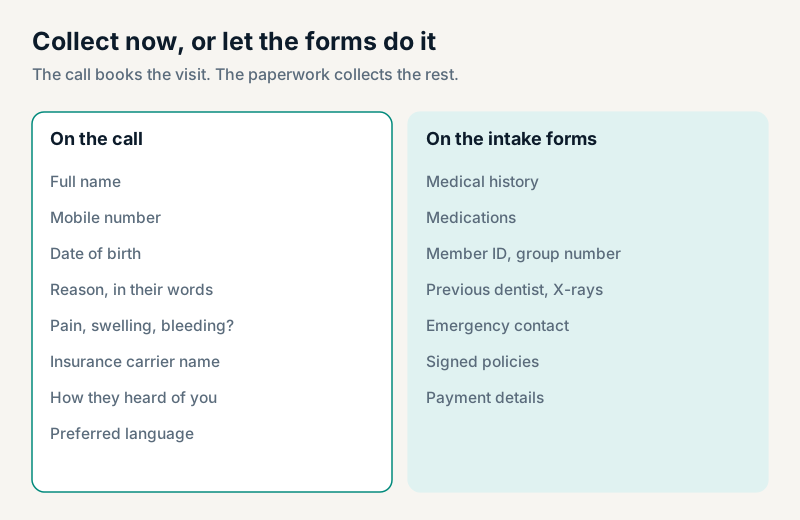
Almost every new patient asks "do you take my insurance?" — and it is the question most likely to get a confident wrong answer. "Take" can mean in-network, out-of-network with reimbursement, or simply "we'll file the claim," and coverage for a specific treatment depends on a plan the caller usually can't describe.
The safe pattern: confirm only what you know for certain (whether you are in network with that carrier), take the carrier name, and promise to check the rest before the visit.
Yes, we're in network with [Carrier]. Bring your card to the visit, and we'll check your benefits before you come in so there are no surprises.
We work with many plans. I don't want to guess about your coverage, so let me take your carrier's name, and we'll check your benefits and call you before the visit. Who is your insurance with?
That's no problem — many of our patients don't have dental insurance. I can tell you what a new-patient exam costs here, and the dentist will go over any treatment and its cost with you before anything is done.
Trabajamos con muchos seguros. No quiero adivinar su cobertura, así que tomo el nombre de su aseguradora y revisamos sus beneficios antes de la cita; le llamamos para confirmarle. ¿Con qué seguro está?
What not to say: "you're covered," "that should be free," or any percentage. If the visit then costs something, the patient remembers the promise, not the plan's fine print.
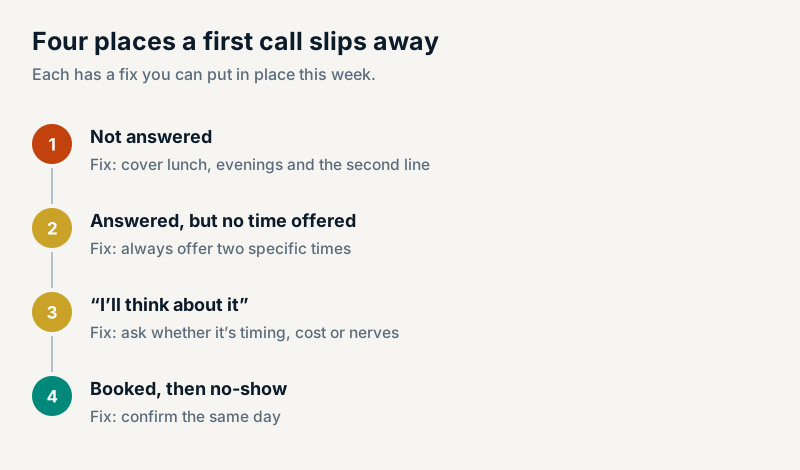
Never ask "when are you free?" — it hands the caller a blank calendar and invites "let me check and call you back." Offer two specific options. If neither works, ask which day of the week usually does.
I have Thursday the [date] at 9:00, or Monday the [date] at 3:30 — which works better? … Perfect, you're booked for [day, time] with [Dentist]. Plan on about an hour. We'll text you our new-patient forms; please bring a photo ID and your insurance card. Is there anything else I can help with?
Tengo el jueves [fecha] a las 9:00 o el lunes [fecha] a las 3:30. ¿Cuál le queda mejor? … Perfecto, queda agendado/a para el [día, hora] con [Dentista]. Calcule alrededor de una hora. Le enviaremos los formularios de paciente nuevo; traiga una identificación con foto y su tarjeta del seguro. ¿Le puedo ayudar en algo más?

"Let me think about it" usually means one of three things: cost, fear, or a schedule problem. Ask, gently, which one — the answer tells you what to say next.
Of course. Can I ask what's on your mind — is it the timing, the cost, or just that it's been a while since you've seen a dentist? We see a lot of people in exactly that spot.
If they still want to wait, take their number and ask permission to follow up: "Would it be all right if I called you on Friday?" Then call on Friday.
Most first calls fit the six steps. These six don't, and they are the ones front desks remember for the wrong reasons.
Take the child's name and date of birth, and the parent's name and number as the contact. Ask whether this is the child's first dental visit — first visits for small children are usually shorter and scheduled at a different time of day, and your dentist will have a preference.
Of course — is this [child's name]'s first visit to a dentist, or have they been seen before? And may I have their date of birth? I'll put you down as the contact for the appointment.
Price shoppers are still new patients. Give the real price of a new-patient exam and cleaning if you have one, explain in one sentence what it includes, and move straight to a time. Refusing to quote a price sounds like hiding one.
For a new patient, the first visit is an exam, X-rays if you need them, and a cleaning — that's [price] without insurance. If the dentist recommends anything else, they'll go over it and the cost with you first. I have Thursday at 9 or Monday at 3:30 — would either work?
Ask why first. A broken tooth or swelling goes through your urgency path; a routine cleaning "as soon as possible" gets the earliest regular slot and a place on the short-notice list.
Let me see what I can do. Is something bothering you today, or are you looking for the first available cleaning? … I don't have anything today, but I have [earliest slot], and I can add you to our list in case someone cancels sooner.
Callers who have been told they need major treatment elsewhere are often anxious about cost or trust. Book a consultation rather than a cleaning, and ask them to bring or request their X-rays and treatment plan, so the visit isn't spent repeating images.
That's a very reasonable thing to want. I'll book a consultation with [Dentist]. If you can, ask your previous office to send your X-rays and treatment plan to us — I'll give you our fax and email — so we don't have to repeat them.
Don't put them on hold to find someone. Say, in simple Spanish, that someone will call back in Spanish, take the number, and make sure it happens the same day. A caller left on hold in a language they don't understand almost always hangs up.
Un momento, por favor. Una persona que habla español le va a llamar hoy mismo. ¿Me da su nombre y su número de teléfono?
Answer it — parking, hours, whether you see children — and then offer a time anyway. People often call "just to ask" because booking feels like a commitment; a friendly offer of two times turns a question into a visit more often than you would think.
One number tells you most of what you need: of the calls from new patients this week, how many ended with a booked appointment? Keep a tally at the desk for two weeks — a simple mark for every new-patient call, and a second mark when it ended in a booking. Then look at the ones that didn't.
Review it again a month later. A front desk that sees its own numbers improves faster than one that is told to "convert more calls."
The script carries the words. These habits carry the tone — and new patients judge the tone before they judge the words.
Lunch, the end of the day, two lines ringing at once — some first calls will reach no one. Two things limit the damage. A voicemail greeting that sounds like a real office and promises a call back (ten ready-to-record greetings are in dental office voicemail greetings), and a habit of returning every missed call within the hour, starting with numbers you don't recognize. What those unanswered calls are worth is worked through in how much missed calls cost a dental practice.
Dentovox handles this call when your team can't: it answers in English or Spanish, asks the same questions in the same order, records urgent symptoms as an urgent callback request for your team, and books the visit straight into Dentrix, Open Dental or Eaglesoft during the call, with the caller's reason written onto the appointment. You can hear it do exactly that on the demo line at (201) 690-2609, or see how the AI receptionist works.
Their reason for calling, whether there is pain, swelling or bleeding, their full name, mobile number and date of birth, how they heard about the practice, their insurance carrier's name, and which of two offered times suits them. The full medical history, member ID and signed policies can wait for the intake forms.
Usually four to six minutes. Longer calls tend to be collecting details the intake forms will collect anyway; shorter ones often skip the urgency check or end without a booked time.
Confirm only what you know for certain — whether you are in network with that carrier — then take the carrier name and promise to check benefits before the visit. Avoid saying a treatment is covered or quoting percentages on the call.
Ask gently whether it is timing, cost or nerves, and answer that specific concern. If they still want to wait, ask permission to follow up on a specific day, and then call on that day.
Where a meaningful share of callers speak Spanish, yes. A caller who can't explain why they are calling in their own language often hangs up and tries another office. The Spanish lines in this script mirror the English ones step by step.
Create an account free — no card — build your receptionist, and hear it handle a call on the spot. Your own number activates when you start a plan.