
In this illustrative scenario, a practice that takes 45 calls on a Tuesday misses 13 of them — about 30%. They cluster before opening, in the morning rush, at lunch and after closing. Three are new patients; at the assumptions shown below, that is roughly $1,000 of first-year value in a single day. Every number is an assumption, not a measurement.
By Viktoria Mols, CMO · Published October 30, 2026 · 11 min read
Lanternhill opens at 8. The front desk is one person, Jen, with a second team member covering phones when the schedule allows. It is a normal Tuesday: a full hygiene schedule, two new-patient exams in the afternoon, nothing unusual. By the time the lights go off at 5, the practice has taken 45 calls. Thirteen of them reached no one at the desk.
Nobody at Lanternhill would describe it as a bad day. That is the point of walking through it hour by hour — the calls that go unanswered are not the result of anyone doing their job badly. They fall into the gaps every small front desk has, and most of them leave no trace beyond a line in the phone system's log that nobody reads.
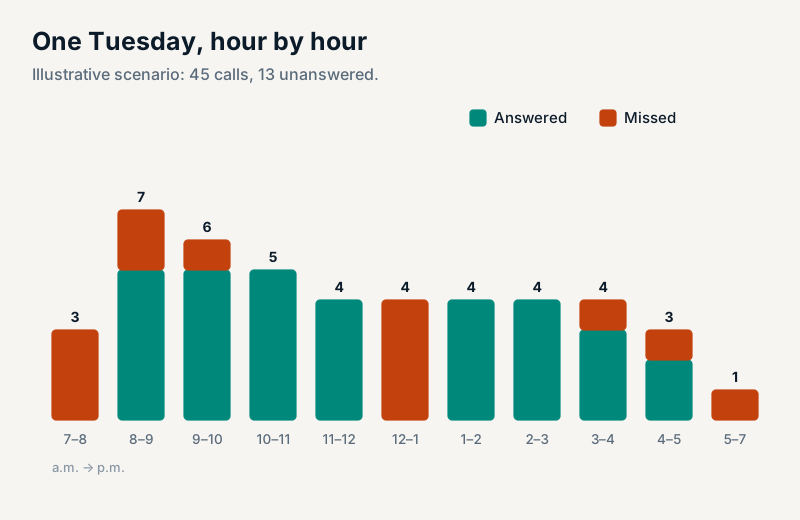
Three calls ring out. One is a man who cracked a tooth on his breakfast and wants to know if he can be seen today; he hears the voicemail greeting, doesn't leave a message, and dials the next practice on his list. One is an existing patient checking her appointment time. One is a vendor. To the phone log, they look identical.
Patients are checking in, a hygienist needs a chart question answered, and both lines ring at once twice. Jen answers ten of thirteen calls. Of the three that go to voicemail, one is a mother rescheduling her children's cleanings, one an insurance question, and one a new patient who just moved to the area. The new patient leaves a message. Jen returns the call at 10:20; by then she has booked with another office.
Nine calls, all answered. This is when the front desk feels on top of things — and it is the stretch most people picture when they say "we answer our phones."
The desk is empty for an hour, as it is in many small practices. Four calls go unanswered: a Spanish-speaking caller looking for a first visit for her husband, a patient wanting to move tomorrow's appointment, a billing question, and a robocall. The Spanish-speaking caller hangs up during the English greeting.
Fifteen calls, thirteen answered. At 3:40 a patient calls to cancel tomorrow's crown seat; Jen works the waitlist and fills it, which is the best thing that happens all day. One call is missed while she is on that waitlist call — an existing patient checking what time her son's appointment was — and one more at 4:50 as the last patients check out: a new patient calling on her way home from work.
At 6:10 p.m. a patient calls with swelling on one side of her face. The voicemail greeting gives the on-call number and tells callers with a medical emergency to call 911. She reaches the dentist on call. That one went right — because the greeting was recorded with care.
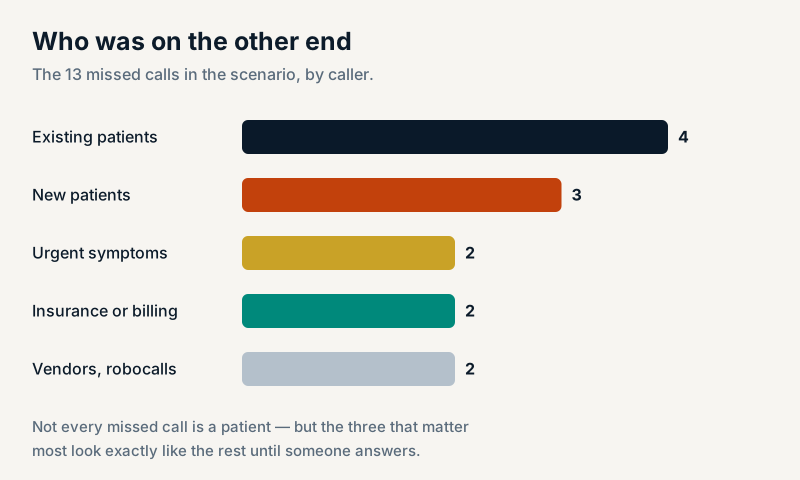
Two of the thirteen weren't patients at all. That matters, because it is the usual objection: "most of our missed calls are spam." Some are. But nothing distinguishes the new patient in the morning rush from the vendor before opening until someone answers — and the three new patients are the calls a practice can least afford to lose, because they have not yet chosen a dentist.
If Lanternhill's phone system sends a weekly summary, it says something like "answer rate: 71%." That number is true and almost useless. It averages the 100% of the calm late morning with the 0% of lunch and the 0% before opening, and the average hides exactly where the problem is. Nobody reads "71%" and thinks "we are closed to callers between 12 and 1."
The same average hides who was calling. A missed robocall and a missed new patient count the same in an answer rate. If you only ever look at the percentage, the practice can improve it — by answering more vendor calls — without booking a single extra patient.
Two views are more useful than any percentage: missed calls by hour, which shows the windows, and missed calls from numbers that never called back, which shows the cost. Both come from the same call log; neither is in most default reports.
It would be easy to read this day as a story about a front desk that falls short. It isn't, and two moments are worth copying.
Both have the same lesson underneath: the front desk does its best work when it isn't also the only thing standing between a ringing phone and voicemail.
Here are the assumptions behind the scenario, the same ones used in our guide to how much missed calls cost a dental practice. Change any of them to match your own practice; the arithmetic stays the same.
| Assumption | Value in the scenario |
|---|---|
| Calls per day | 45 |
| Share unanswered | 13 of 45 ≈ 29% |
| Missed calls that are new patients | About a quarter — 3 of 13 |
| New callers who would book if reached | Half |
| First-year value of a new patient | $650 |
Three new-patient calls, half of whom would have booked, at $650 each, is roughly $1,000 of first-year value from one ordinary Tuesday — and the existing patients and the urgent caller who went elsewhere are on top of that. Over the 21 working days of a month the same pattern adds up to about $20,000 in first-year value, which is in line with the worked example in our missed-call guide. These are illustrative assumptions, not Dentovox's measured results; your own call log will tell you your real numbers.
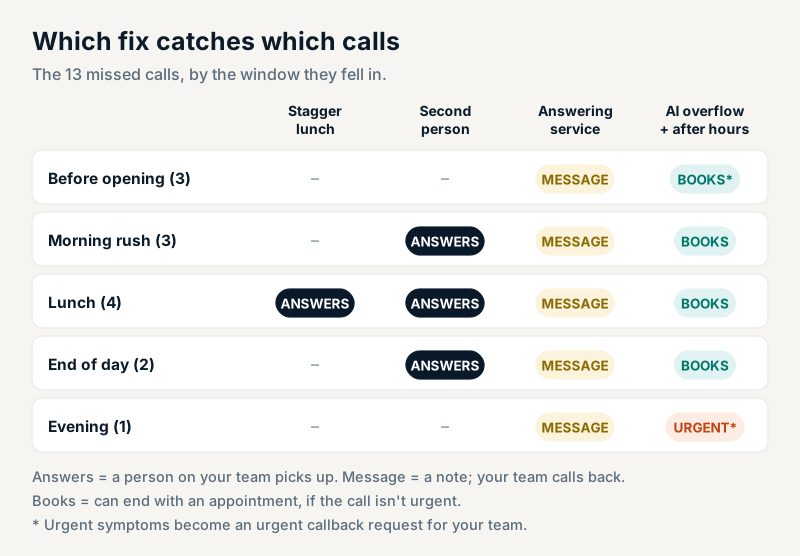
Each common fix catches a different slice of those thirteen calls. None of them is wrong; they solve different problems.
The scenario is invented; your phone log is not. In about half an hour you can see your own version of the chart at the top of this page:
For the words to use when the phone is answered, see the new patient phone script; for the greeting callers hear when it isn't, see dental office voicemail greetings. And if you want to hear how Lanternhill's calls would sound answered by Dentovox, call the demo line at (201) 690-2609 — it is the same invented practice, answering around the clock.
What to look for in the phone system itself — overflow rules, missed-call reports, caller ID linked to your records — is covered in dental office phone systems: what to look for.
Missed calls cluster where staff can't pick up: before opening, during the morning check-in rush when two lines ring at once, at lunch if the desk is empty, at the end of the day, and after closing. The best way to see your own pattern is to group a week of your call log by hour.
Some are — vendors and robocalls. But a missed call from a new patient looks the same in the log until someone answers it, and new patients are the callers most likely to try another practice instead of calling back.
No. Lanternhill Family Dental is a practice Dentovox invented for its demo line and examples. The callers in this article are not real people, and all figures come from the stated assumptions, not from measurements.
Staggering lunch breaks so someone is always at the desk costs nothing but scheduling effort. If that isn't possible, forwarding the line on overflow during lunch to an answering service or an AI receptionist covers it.
Create an account free — no card — build your receptionist, and hear it handle a call on the spot. Your own number activates when you start a plan.