
A dental answering service picks up the calls your front desk can't — after hours, at lunch, during peak volume. There are three types: message-taking services, live virtual receptionists, and AI receptionists. Only the third answers instantly, in English or Spanish, and writes the appointment into Dentrix, Open Dental, or Eaglesoft during the call.
By Viktoria Mols, CMO · Updated September 14, 2026
A dental office runs on a phone line that rings hardest at the exact moments no one can pick it up: the lunch hour, the 5-to-8 p.m. window when patients finally have time to call, Saturdays, and the ordinary chaos of two lines ringing while one person checks a patient out. Industry estimates commonly put unanswered inbound calls at 25–35% of total volume†, and callers who reach voicemail overwhelmingly do not leave a message — they call the next office on the list.
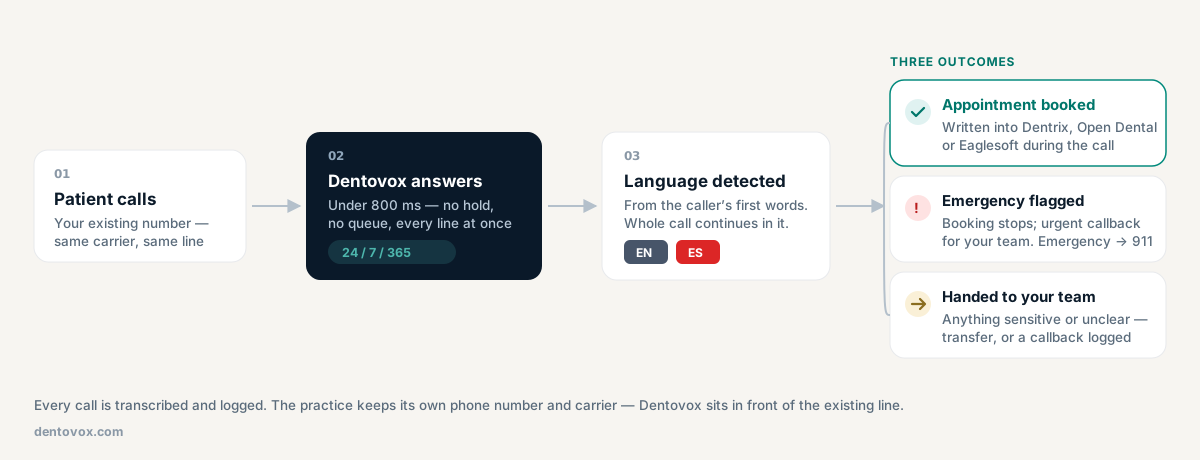
An answering service exists to close that gap. The question is not whether to cover the calls, it's what "covering" means: taking a message, holding a conversation, or actually booking the appointment. That distinction is worth real money, and it's the whole reason this page exists. If you want the plain definition first, our deep dive on what a dental answering service is covers the terminology; this page is the wider decision — types, costs, dentistry-specific requirements, and how to evaluate a provider.
Almost every option on the market is one of three things.
1. Message-taking (traditional answering service). A remote operator, usually not dental-specific, picks up, takes a name and number, and emails or texts it to the office. Nothing is booked. The patient waits for a callback that may come the next business day. Billing is typically per minute or per call, so a good marketing month raises your bill.
2. Live virtual receptionist. A trained human — sometimes dental-trained — answers, can talk through insurance or hours, and in better setups can access a scheduling system. Quality is high when the right person answers. The constraints are the usual human ones: hold times at peak, limited hours in the plans most practices can afford, turnover, and cost that scales with minutes.
3. AI receptionist. Software answers on the first ring, every hour, holds a real conversation, and — if it's integrated — writes the appointment into your practice management system while the caller is still on the line. No hold queue, no per-minute billing inside the included minutes, consistent on the 400th call of the month as on the first. This is what Dentovox's AI receptionist is.
| Message-taking | Live virtual receptionist | AI receptionist (Dentovox) | |
|---|---|---|---|
| Answers after hours | Usually | Depends on plan | 24/7 |
| Time to answer | Queue | Queue at peak | Under 800 ms |
| Books into the PMS | No | Sometimes | Yes, during the call |
| Spanish | Add-on / transfer | Depends who answers | Built in, both languages |
| Two-way SMS follow-up | Rare | Rare | Built, EN + ES — activating after carrier registration |
| Calls lapsed patients back | No | No | Yes (reactivation) |
| Pricing model | Per minute / per call | Per minute / per hour | Flat monthly per location |
Costs split along the pricing model, not just the price. Metered services (per minute, per call) are cheap in a slow month and expensive in a busy one — which means the service costs you most exactly when it's working. Flat monthly pricing is predictable and doesn't penalize a successful marketing campaign.
Dentovox is flat, per location, per month: Overflow $299, Front Desk $499, Revenue $749, and Multi-Location $649 per location, with 10% off annual billing. Full detail is on the pricing page. The three billing models, and the fees that sit outside a quote, are broken down in what a dental answering service costs.
Example math for framing the decision: if your first-year value per new patient is $650, one extra booked new patient a month covers a Front Desk subscription with room to spare. Two covers it comfortably. That's the entire arithmetic — you're not buying call coverage, you're buying the bookings that were falling out of it. Put your own numbers in the ROI calculator, or read how much missed calls cost a dental practice for the full formula.
Most answering services are horizontal — the same operators handle a plumber, a law office, and a dental practice. Dentistry has requirements that generic coverage simply doesn't meet.
Six questions separate the real options from the ones that just pick up the phone.
One more, which almost nobody asks: does it only answer, or does it also reach out? Inbound coverage protects the patients calling you today. The patients who stopped coming last year are a separate and often larger pool — see patient reactivation and our guide to reactivating lapsed dental patients.
A dental answering service handles inbound calls a practice cannot pick up itself — after hours, at lunch, during peak volume. Options range from a plain message-taking service to a live virtual receptionist to an AI receptionist that answers instantly and writes the appointment into the practice management system during the call.
Message-taking services usually bill per minute or per call, so the bill rises with call volume. Live virtual receptionists cost more per minute because a person is on the line. Dentovox is flat monthly per location: Overflow $299, Front Desk $499, Revenue $749, and Multi-Location $649 per location per month, with 10% off on annual billing.
Only if it is integrated with your PMS. Many services just take a message and email it to the front desk. Dentovox connects through NexHealth to Dentrix, Open Dental, and Eaglesoft, and writes the appointment into the schedule during the call, with double-booking protection so two callers cannot take the same slot.
Most generic services offer Spanish only as a paid add-on or a transfer to a separate queue. Dentovox is bilingual by default: it detects the caller's language on the call and continues the whole conversation in English or Spanish; text follow-ups will use the same language once texting activates after US carrier registration.
It should recognize urgent language, follow your practice's escalation rule, and get urgent callers to your team fast. Dentovox stops the booking flow on urgent symptoms and flags the call to your team as an urgent callback request. It is not an emergency service — in a medical or dental emergency, callers should dial 911 or go to the nearest emergency room.
Any vendor that handles patient information on your behalf is a business associate and should sign a Business Associate Agreement. Dentovox is built HIPAA-aware and signs a BAA. Ask any provider for their BAA and their security documentation before you send them a single call.
† Industry estimates, not Dentovox's measured results. Example math is illustrative — use your practice's own numbers in the ROI calculator. Nothing here is legal advice; consult your counsel on TCPA, consent, and HIPAA obligations.
If you are weighing answering coverage against a platform that also calls patients back, the status of every workflow is on the AI receptionist + patient recovery page, and a named comparison is in Dentovox vs Viva AI.
Create an account free — no card — build your receptionist, and hear it handle a call on the spot. Your own number activates when you start a plan.